

Last week I invaded Art Basel Miami 2025 and on the bus ride down to Miami I decided to show off the latest and greatest in crypto / art / tech. I knew I wanted to do some kind of neo-dada performance art – and show something new, relevant, and timely. Once I landed at my buddy’s place, I decided to spend the morning of the show vibe coding a series of gonzo live apps late into the night that did several things:
- Unnerve those who were there, using
- Discordant frequencies
- Face tracking (simulated, without sending data – actual surveillance? that’s Art Basel’s job)
- Dirty Low-Fi aesthetics
- Simulate a dreary Matrix type of scenario
- Troll my main crypto adversaries / compatriots
After some proper substance abuse (don’t worry, just K, mushrooms, and mescaline) and tons of energy drinks and coffee later, I settled on 3 variants of:
The 3 Sheeple Detector Prototypes

༒

༒
༒
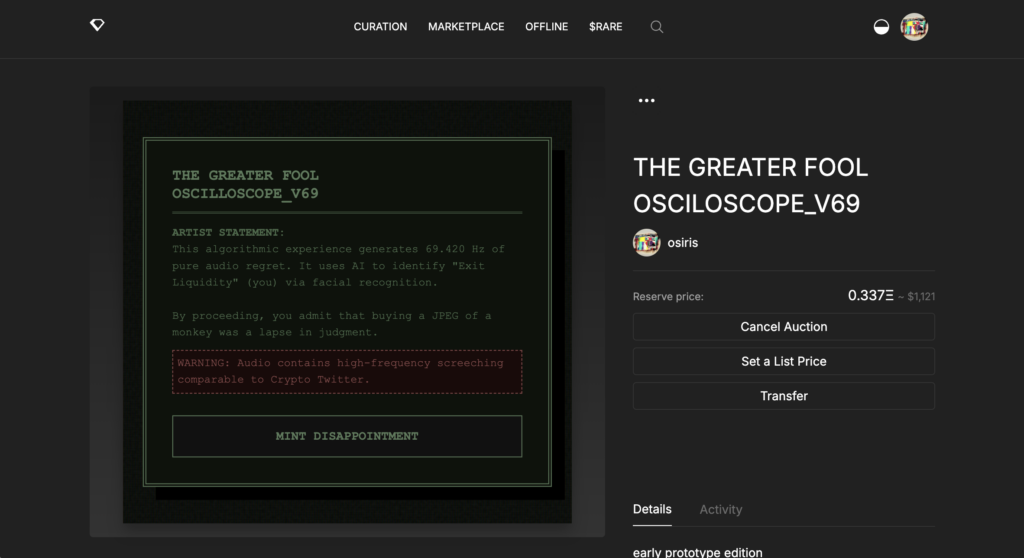
This is a satirical, interactive art application designed to mock cryptocurrency culture (specifically NFTs), bureaucratic dystopias, and the user’s (or sheeple’s) own vanity. It presents itself as a “Value Absorber” that uses AI to mathematically judge the user’s “aesthetic worth.”
Here is a detailed breakdown of what the web app does, divided by User Experience and Technical Functionality.
1. The User Experience (The “Vibe”)
The Aesthetic:
- Visual Style: The app looks like a 1990s Unix terminal found in a derelict bunker. It uses a color palette described in the code as “Drab, bureaucratic green.”
- Visual Effects: It applies a “vignette” (dark corners) and “scanlines” (CRT TV lines) to make the screen look like an old, dirty monitor.
- The Cursor: The mouse cursor is forced to the
waiticon (the spinning hourglass or circle) permanently to annoy the user (commented in code as a “Subtle insult”).
The Intro Screen:
- The user is greeted with a terminal window titled “Sheeple Detector.”
- It displays a “Subject Analysis” claiming the user’s estimated value is
0.0000 ETH. - It asks for camera permission to “mint your insecurity on the blockchain.”
- The button to start reads: “I CONSENT TO JUDGMENT.”
The Active State (Once “Start” is clicked):
- The Mirror: The app activates the webcam. The video feed is shown in black and white with high contrast and a green tint, described in the code as a “Depression Filter.”
- The Sound: It generates a continuous, low-frequency drone (humming at 69.420 Hz—a meme number). Every ~25 seconds, the audio “crashes” (simulating a crypto market crash) by sweeping up to a painful “mosquito tone” (17,000 Hz) before resetting.
- The Judgment (AI): The app detects the user’s face. It draws a jittery box around their head and assigns a label that flickers. Instead of saying “Person,” it labels the user with insults from a database, including:
- “EXIT LIQUIDITY”
- “BAG HOLDER”
- “GAS FEE DONOR”
- “PAPER HANDS”
- “PRE-RICH”
- Subtext: Under the face box, it always displays
CONFIDENCE: 0.0%.
Interaction:
- If the user tries to touch or click the video feed, a modal pops up rejecting them. It refuses to let them “touch the art,” displaying messages like:
- “Your biometrics have been declined. Too moist.”
- “Right-click saver detected.”
- “Stop. You are depreciating the value.”
2. Technical Implementation
Libraries Used:
- TensorFlow.js & BlazeFace: Used for real-time face detection in the browser.
Audio Engine (Web Audio API):
- It does not play an MP3; it generates sound procedurally using Oscillators.
- Carrier Wave: A sawtooth wave (harsh buzz) set to a base frequency.
- Modulation: A “chaos” variable randomly changes the pitch and dissonance to create anxiety.
- Events: A
startChaosLoopfunction randomly triggers “glitches” or “sweeps” to ensure the audio is never comfortable.
Visual Rendering (HTML5 Canvas):
- Video Processing: It draws the video frame to a canvas but manipulates the pixels using CSS filters (
grayscale(100%),contrast(1+)). - Oscilloscope: It draws a wavy line across the center of the screen. This is fake; it is not reacting to real audio data but rather uses math (
Math.sin) combined with a random “chaos” variable to look like it is analyzing data. - Face Tracking: It loops through the predictions from BlazeFace. It applies a random “jitter” to the coordinates of the bounding box to make the tracking look unstable and glitchy.
- Text Glitching: The code randomly replaces characters in the insult labels with symbols (e.g., changing “E” to “#”) based on the current chaos level.
Dynamic Color System:
- The app calculates a color palette in real-time.
- If the “Chaos” level is low (boring), the UI is green.
- If the “Chaos” level hits 1.0 (during the audio scream/market crash), the UI shifts to Red/Alert colors.
Summary
This code is a piece of Real-Time Generative Performance Crypto Art. It functions as a functional face-tracking mirror, but every design choice—from the annoying audio to the insulting labels—is programmed to troll the user and satirize the concept of digital value in the NFT era – and the industry darlings of the new “digital art” space.
The Collection
The collection of actual snaps of Dirty Beeps in action at Art Basel 2025 during Zero10 are available to collect here:

A total of 66 snaps were taken during the event – the first 22 are now available as collector’s items on OpeanSea for 0.07 ETH each (~$240) and feature Beeple and his psycho dogs, Jack Butcher, myself, Quasimondo, and some of the “sheeple” that were at the event.
If you want to support gonzo cryptoart projects of this type in the future, feel free to pick up a piece of cryptoart history yourself. 🙏🏼✨


Leave a Reply